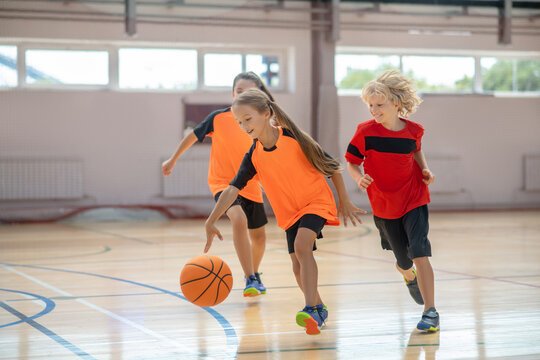
Basketball has changed greatly since its creation and as a result of this, so has the way it is being taught. I have worked with young athletes of all ages and levels and these are a few ideas I think could be used to improve the game.
- More 3v3 Competition for Youth
- Recently, I attended a youth rec league game for 7-8 year olds. This was a league that was put on by a city program and was focused more on development and just simply having fun. One of the things I observed was how on each team there were often 1-2 players that had the ball in their hands 90% of the time. Basketball is not an equal-opportunity sport, but at younger levels it is important that players have the opportunity to develop and test out their skills they are learning. Lesser-skilled players often “hide” and are not given the opportunity to develop. The solution to this problem would be to have 3 on 3 half-court leagues. Players cannot “hide” and have more opportunities to have the ball. In addition, young players often get lost in transition (either from defense to offense or vice-versa) and this would help this problem. I believe the U.S. soccer federation does a good job of implementing small-sided games to help develop younger players. The U.S soccer federation created leagues for players between 6-8 years old where 4 on 4 is played. As they grow older they advance to 7v7, 9v9, and finally 11v11 for athletes at the U13 (under 13) level. Youth leagues should implement more small-sided games into their programs and leagues.
- More Practices/Training than Games
- It seems that many AAU teams and youth programs are more concerned about competition than practices. To be clear, games are important and players need to be able to practice their skills they learn, but there should still be more practices/workouts taking place than games. I know of many AAU teams that will practice once per week and then play 4-5 games each weekend. I recently heard a coach provide a comparison that I feel sums this issue up well. He compared basketball to the education-system and explained how you spend significantly more time studying than taking an exam. Practice can be viewed as ‘studying,’ while games or tournaments can be viewed as exams where you are testing your development. We would not expect a student to take a test without teaching them, so we cannot be upset at athletes when they cannot perform skills in games when they have not had adequate time to practice.
- More Coaching Certifications/Training
- It does not take much to become an AAU coach these days. For lower-levels of AAU, there are not any required trainings or certifications that coaches need. This should change. Coaches need to know about the latest coaching techniques and practices that are put in place to better serve their young athletes. Looking at the U.S. soccer federation again, certain licenses are needed to coach teams in certain tournaments. Many competitive level tournaments require coaches to have a specific coaching license to be able to coach. This ensures that each coach that is coaching has had some professional development in coaching. While I believe this does exist at the highest level of AAU, all AAU coaches should be required to do some form of coaching training and licensing to coach their teams in tournaments.
I will do a part two on this topic next week with some more ideas. Please comment your thoughts below and I would love to hear your thoughts on this topic. Thanks!
Links to sources used: https://www.ussoccer.com/stories/2018/08/five-things-to-know-about-us-soccers-7v7-9v9-and-11v11-online-grassroots-coaching-education-courses


 Tower Bridge Hoops
Leave a reply to apritter3 Cancel reply